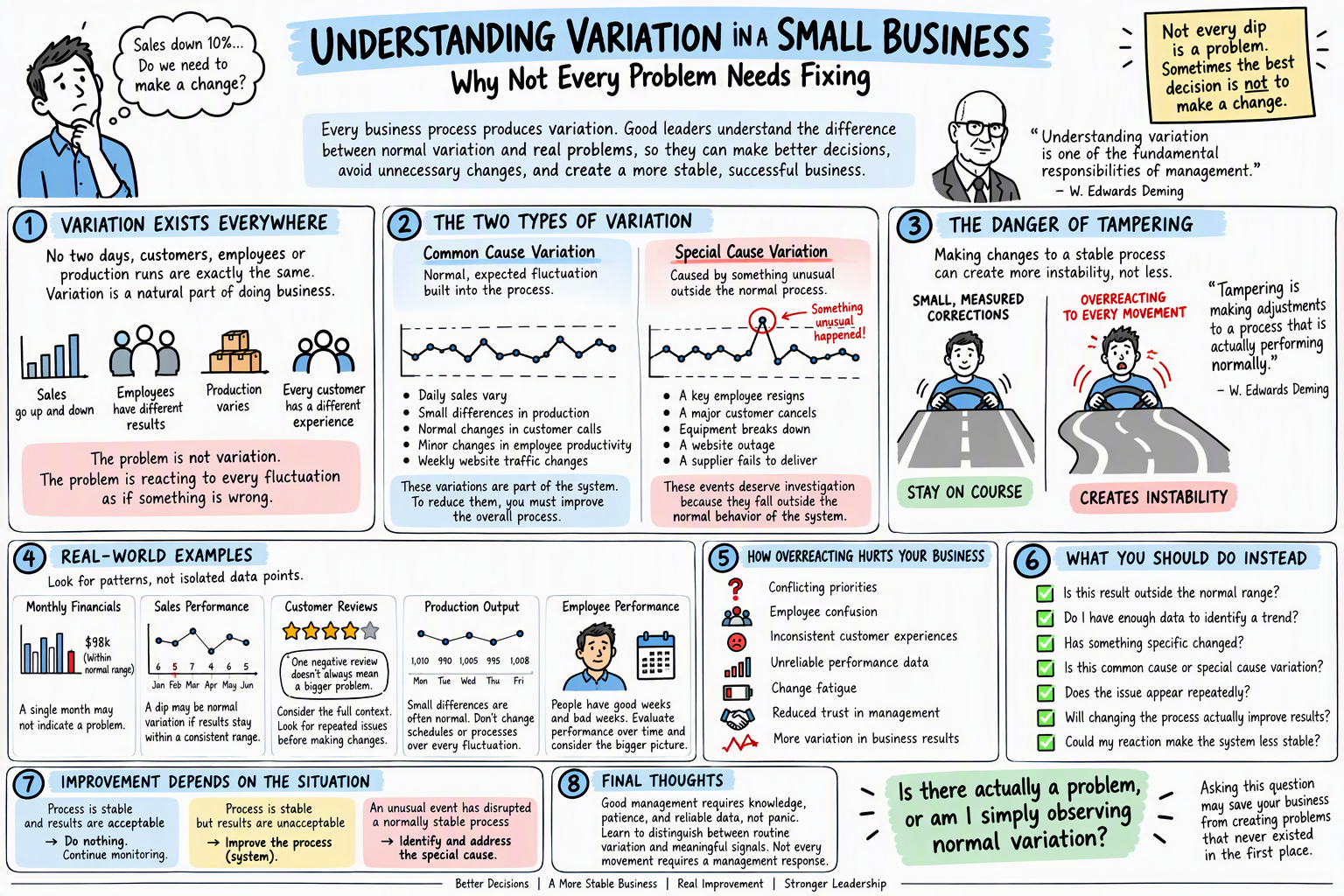
Understanding Variation in a Small Business: Why Not Every Problem Needs Fixing
One of the hardest lessons for business owners to learn is that not every dip in performance is a problem.
Sales fall by 10% one week, and panic sets in.
A customer leaves a negative review, and suddenly everyone is discussing changes to the customer service process.
An employee has an off month, and concerns arise about performance.
I've seen this happen in organizations of every size. Leaders care deeply about results, so when numbers move in the wrong direction, the instinct is to react immediately. The challenge is that not all variation indicates something is wrong.
- Edwards Deming taught that understanding variation is one of the fundamental responsibilities of management. Without that understanding, leaders end up chasing random fluctuations, making unnecessary changes, and unintentionally creating more instability than they eliminate.
In many cases, the best decision is not to make a change at all.
Why Variation Exists Everywhere
Every business process produces variation.
No two sales months are identical.
No two employees perform at exactly the same level every day.
No two production runs generate precisely the same results.
No two customers have exactly the same experience.
Variation is a natural part of doing business.
The problem occurs when leaders treat every fluctuation as evidence that something has gone wrong.
When normal variation is mistaken for a real problem, management often begins changing processes, priorities, goals, incentives, and expectations unnecessarily.
Instead of improving performance, these changes create confusion and instability.
The first step toward better leadership is understanding the two types of variation Deming described: common cause variation and special cause variation.
Common Cause vs. Special Cause Variation
Common Cause Variation
Common cause variation is the normal fluctuation built into a process.
It represents the routine ups and downs that occur even when nothing unusual has happened.
Examples include:
- Daily sales varying from one day to another
- Small differences in production output
- Normal fluctuations in customer call volume
- Minor changes in employee productivity
- Weekly changes in website traffic
These variations are expected because they are part of the system itself.
If you want to reduce common cause variation or improve performance, you must improve the overall process.
Special Cause Variation
Special cause variation occurs when something unusual affects the process.
This type of variation comes from a specific event, change, or disruption.
Examples include:
- A key employee unexpectedly resigning
- A major customer canceling an order
- A critical piece of equipment breaking down
- A website outage disrupting online sales
- A supplier failing to deliver essential materials
These events deserve investigation because they fall outside the normal behavior of the system.
The challenge for leaders is knowing the difference.
Too many managers react to common cause variation as if it were a special cause. That mistake leads to what Deming called tampering.
The Danger of Tampering with a Stable Process
Deming used the term tampering to describe making adjustments to a process that is actually performing normally.
Imagine driving a car down the highway.
The vehicle naturally moves slightly within the lane. A good driver makes small, measured corrections and continues forward.
Now imagine aggressively jerking the steering wheel every time the car moves an inch to the left or right.
The result would be instability, not improvement.
Businesses often do the same thing.
A sales number drops, so management changes the sales process.
The following month, sales increase, and management assumes the change worked.
Then sales fall again, so another change is introduced.
Over time, the organization experiences constant change with little actual improvement because leadership is reacting to noise rather than meaningful signals.
Many businesses unknowingly create their own instability through overreaction.
Why Monthly Financial Statements Can Mislead
Monthly financial statements are important, but they can also be misleading when viewed in isolation.
Suppose a business typically generates between $95,000 and $110,000 in monthly revenue.
One month finishes at $98,000.
Management immediately launches meetings to determine what went wrong.
But did anything actually go wrong?
Perhaps not.
If that result falls within the normal operating range of the business, it may simply reflect routine variation.
The same issue can occur with:
- Monthly profit
- Labor costs
- Material costs
- Customer inquiries
- New sales leads
- Website traffic
- Customer acquisition costs
A single month's results rarely tell the entire story.
Effective leaders look for patterns and trends over time rather than reacting to individual data points. They ask:
- Is this result genuinely unusual?
- Is it part of a longer trend?
- Has something specific changed?
- Is the process behaving differently than it normally does?
These questions lead to better decisions than panic-driven reactions.
Why One Bad Customer Review May Not Indicate a Trend
Every business receives negative feedback eventually.
Even organizations with excellent products and outstanding service will encounter dissatisfied customers.
The mistake many owners make is assuming that a single complaint represents a widespread problem.
One negative customer review might reveal:
- A system issue worth investigating
- A misunderstanding
- An isolated mistake
- An unreasonable expectation
- A situation outside the company's control
Without additional data, it is difficult to know which explanation is correct.
That does not mean bad reviews should be ignored. It means they should be considered within the broader context of customer feedback and business performance.
If one negative review appears among hundreds of positive customer interactions, it may reflect normal variation.
If negative feedback begins appearing consistently around the same issue, it may indicate a meaningful change that requires action.
The difference matters.
Sales Example: Is There Really a Problem?
Imagine a salesperson who closes:
- 6 deals in January
- 5 deals in February
- 7 deals in March
- 4 deals in April
- 6 deals in May
- 5 deals in June
Many managers would become concerned about the month with four closed deals.
But should they?
Looking at the broader pattern, the results appear relatively stable. The salesperson consistently closes between four and seven deals per month.
The April result may simply be normal variation.
Now consider another scenario:
- 6 deals in January
- 5 deals in February
- 6 deals in March
- 7 deals in April
- 2 deals in May
- 1 deal in June
This pattern may indicate a special cause worth investigating.
Perhaps the sales territory changed. Maybe the quality or quantity of leads declined. A competitor may have introduced a strong new offer. The salesperson may also be dealing with an obstacle that management needs to address.
The point is not to ignore performance changes. It is to investigate patterns rather than drawing conclusions from isolated fluctuations.
Customer Service Example
Many companies measure customer satisfaction scores weekly.
One week, the score is 92%.
The following week, it falls to 89%.
Management immediately launches a new improvement initiative.
The next week, the score rises to 93%.
Was there really a problem?
Maybe not.
Small changes within an expected range are often normal. A genuine issue becomes more apparent when the data consistently shifts beyond its established pattern or when repeated complaints involve the same problem.
Without understanding variation, leaders can spend valuable time solving problems that never existed.
Production Example
Manufacturing organizations frequently encounter variations in production output.
Consider a production line that completes:
- 1,010 units on Monday
- 990 units on Tuesday
- 1,005 units on Wednesday
- 995 units on Thursday
- 1,008 units on Friday
These results appear remarkably consistent.
Yet some supervisors may treat the 990-unit day as a performance issue and begin changing staffing assignments, work instructions, schedules, or production targets.
In reality, the variation may be completely normal.
Attempting to correct every fluctuation can increase waste, confusion, and employee frustration without improving performance.
If the process is stable but its average output is still too low, management should focus on improving the process itself rather than blaming an individual day, shift, or employee.
Employee Performance Example
Many managers evaluate employees based on short-term results.
An employee has one difficult week or a disappointing month, and concerns immediately arise about performance.
But people do not operate under identical conditions every day.
Workloads change.
Customers have different needs.
Projects vary in complexity.
Equipment and software can create delays.
Information may be incomplete or arrive late.
External circumstances can influence results.
Strong leaders examine employee performance over time rather than drawing conclusions from isolated data points. They also consider whether changes in the system are affecting the employee's ability to succeed.
This approach is fairer to employees and more useful to the business.
How Overreacting Creates Instability
Frequent management changes may seem responsive, but they can make it difficult to determine what is actually improving performance.
If leaders constantly change goals, processes, incentives, schedules, and responsibilities, employees never have enough time to understand or stabilize the work.
Overreaction can create:
- Conflicting priorities
- Employee confusion
- Inconsistent customer experiences
- Unreliable performance data
- Change fatigue
- Reduced trust in management
- More variation in business results
Leaders should remain responsive to genuine problems, but responsiveness is not the same as reacting to every movement in a metric.
Good management requires enough patience to understand what the data is actually saying.
What Small Business Owners Should Do Instead
Rather than reacting to every fluctuation, focus on understanding the behavior of the systems within the business.
When performance changes, ask:
- Is this result outside the normal range?
- Do I have enough data to identify a trend?
- Has something specific changed?
- Is this common cause or special cause variation?
- Does the issue appear repeatedly?
- Will changing the process actually improve results?
- Could my reaction make the system less stable?
These questions help separate meaningful signals from routine noise.
More importantly, they reduce the risk that leaders will create new problems through unnecessary changes.
Don't Tamper with a Stable Process
One of the most valuable leadership habits is learning when not to intervene.
This does not mean accepting poor performance or ignoring warning signs. It means understanding whether the process has actually changed before taking corrective action.
If a process is stable but produces unacceptable results, improve the system.
If an unusual event has disrupted a normally stable process, identify and address the special cause.
If the results remain within the expected range and there is no meaningful trend, avoid changing the process simply because one data point is disappointing.
Not every movement requires a management response.
Final Thoughts
One of Deming's greatest insights was that management's job is not simply to respond to results. It is to understand the system that produces those results.
Unfortunately, many business leaders spend an enormous amount of time reacting to normal variation.
They change processes because of one bad month.
They question employees because of one disappointing week.
They overhaul procedures because of one customer complaint.
In doing so, they can make a stable system less stable.
The best leaders learn to distinguish between routine variation and meaningful signals. They understand that improvement requires knowledge, patience, and reliable data, not panic.
Before making a change, ask yourself:
Is there actually a problem, or am I simply observing normal variation?
The answer to that question may save your business from creating problems that never existed in the first place.
Sources
-
- Edwards Deming, Out of the Crisis
-
- Edwards Deming, The New Economics for Industry, Government, Education
- The Deming Institute, teachings on variation and statistical thinking
- Donald J. Wheeler, Understanding Variation: The Key to Managing Chaos
- Walter A. Shewhart, Economic Control of Quality of Manufactured Product
- American Society for Quality resources on statistical process control and variation
- Peter Scholtes, The Leader's Handbook
- George E. P. Box, research and writings on statistics, process control, and variation