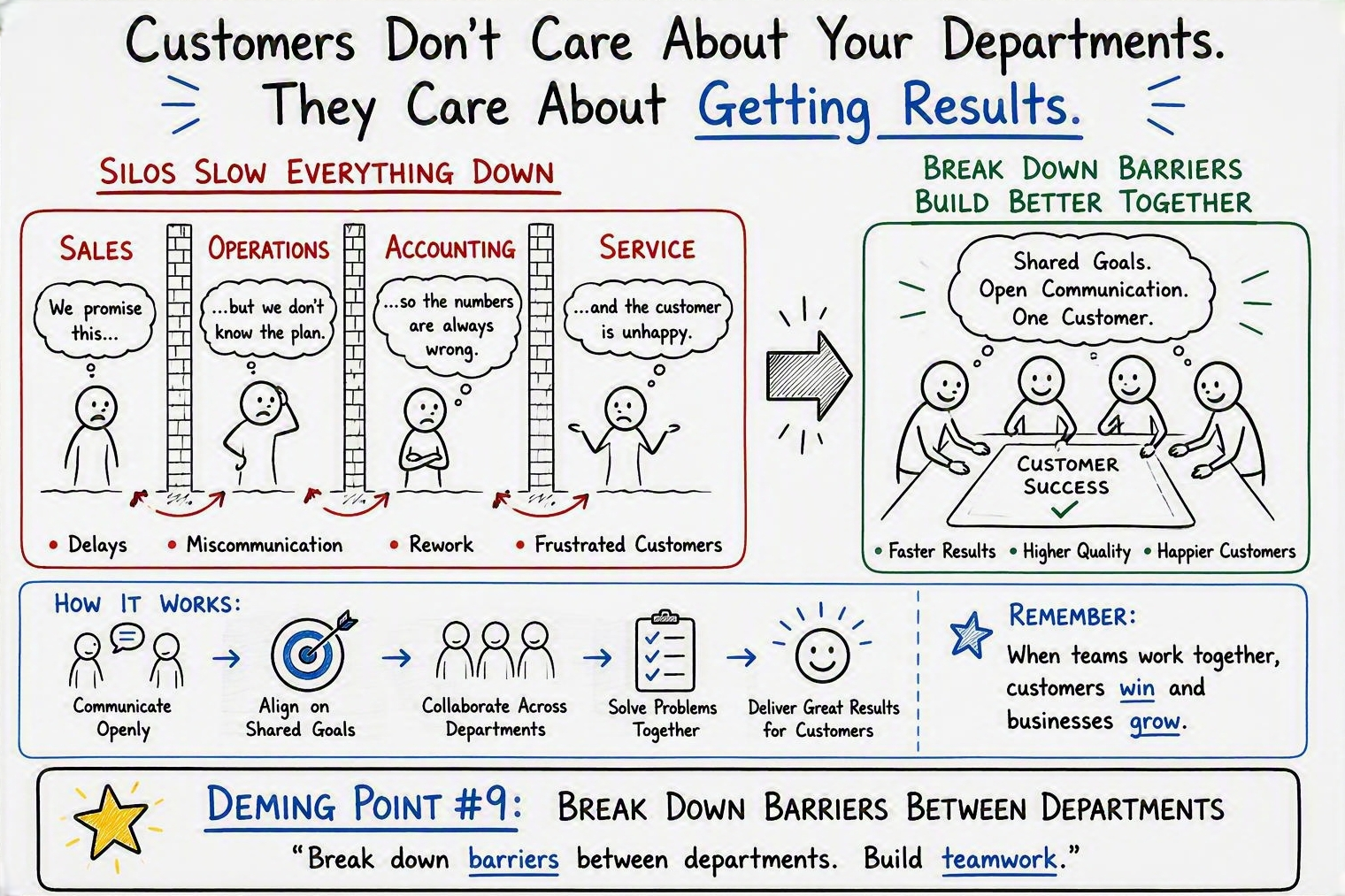
Deming Point #9: Break Down Barriers Between Departments One of the biggest obstacles to growth is not a lack of talent. It's not a lack of effort. And it's often not a lack of resources. It's when different parts of an organization stop working together. That's why Deming included Point #9: Break Down Barriers Between Departments in his 14 Points for Management.
"People in research, design, sales, and production must work as a team." Deming believed organizations perform best when departments collaborate to solve problems and improve the entire system, not just their individual area. Many small business owners read this point and think: "We only have 10 or 20 employees. We don't really have departments." In reality, almost every business has functional silos: Sales Operations Customer Service Accounting Production Purchasing Marketing Even in a five-person company, barriers can exist. The Problem With Functional Silos Have you ever heard these statements? "That's not my job." "Sales promised something we can't deliver." "Operations always slows everything down." "Accounting is making things difficult." "Nobody told us the customer needed that." These aren't people problems. They're system problems. When departments optimize only for their own goals, the customer often suffers. For example: Sales wants to maximize orders. Operations wants stable schedules. Purchasing wants lower costs. Accounting wants tighter controls. Each goal makes sense on its own. But without collaboration, those goals can work against each other. Deming emphasized that organizations should be managed as systems, not as isolated functions. Why This Hits Small Businesses Hard In large organizations, silos are frustrating. In small businesses, they can be devastating. When one employee doesn't share information: Customers wait longer. Mistakes increase. Work gets duplicated. Opportunities are missed. Because teams are small, a single communication breakdown can impact the entire organization. The upside? Small businesses can solve these problems much faster than large corporations. A Real-World Example: Google Google's Project Aristotle studied 180 teams to determine what separated high-performing teams from average ones. One of the major findings was that team effectiveness depends heavily on collaboration, communication, and shared understanding. Researchers discovered that successful teams worked together effectively across roles, exchanged information openly, and created environments where people could contribute regardless of title or function. Google learned something Deming had been teaching decades earlier: The performance of the system is more important than the performance of any individual component. The lesson for small businesses is straightforward: Great organizations don't win because departments perform independently. They win because departments work together. What Collaboration Looks Like Organizations often say they want teamwork. True collaboration looks like: ✅ Sales understanding operational constraints ✅ Operations understanding customer expectations ✅ Accounting understanding business priorities ✅ Customer service sharing recurring issues ✅ Leadership communicating organizational goals Everyone should understand how their work impacts the next person in the process. Five Practical Actions for Small Business Leaders
- Map Your Customer Journey Follow a customer request from beginning to end. Ask: Where are the handoffs? Most communication breakdowns occur during transitions between people or functions.
- Hold Cross-Functional Meetings Periodically bring together: Sales Operations Customer Service Accounting Production Discuss challenges from each perspective. You'll often uncover issues no single group can see alone.
- Share Customer Feedback Widely Don't let customer information stay confined to one area. When everyone understands customer needs, decision-making improves.
- Create Shared Goals Instead of measuring only departmental success, include goals such as: Customer satisfaction On-time delivery Quality Response time Shared goals encourage collaboration.
- Encourage Job Shadowing Have employees spend time observing other functions. Understanding someone else's challenges often builds empathy and improves communication. The Leadership Challenge Many barriers between departments are unintentionally created by leadership. For example: Competing incentives Poor communication Conflicting priorities Limited visibility People rarely wake up intending to create silos. Most simply optimize for what they're being measured on. Leaders must create alignment. What This Means for Growth As businesses grow, complexity increases. More people More customers More systems More specialization Without intentional collaboration, those complexities become silos. Deming understood that organizations improve when people view themselves as part of one system working toward a common purpose. The most successful organizations don't have the best departments. They have departments that work together exceptionally well. Final Thought Your customers don't experience your departments separately. They experience your business as one system. They don't care whether Sales caused the problem. Or Operations. Or Accounting. They simply remember the outcome. Deming's Point #9 reminds us that the goal isn't to optimize individual departments. The goal is to optimize the entire organization. The most effective organizations are not those with the strongest individual functions, but those that create alignment, communication, and collaboration across the entire system. Where do you see the biggest communication or collaboration barrier in your organization today?